
Relativity
Relativity by M. C. Escher (1898–1972)
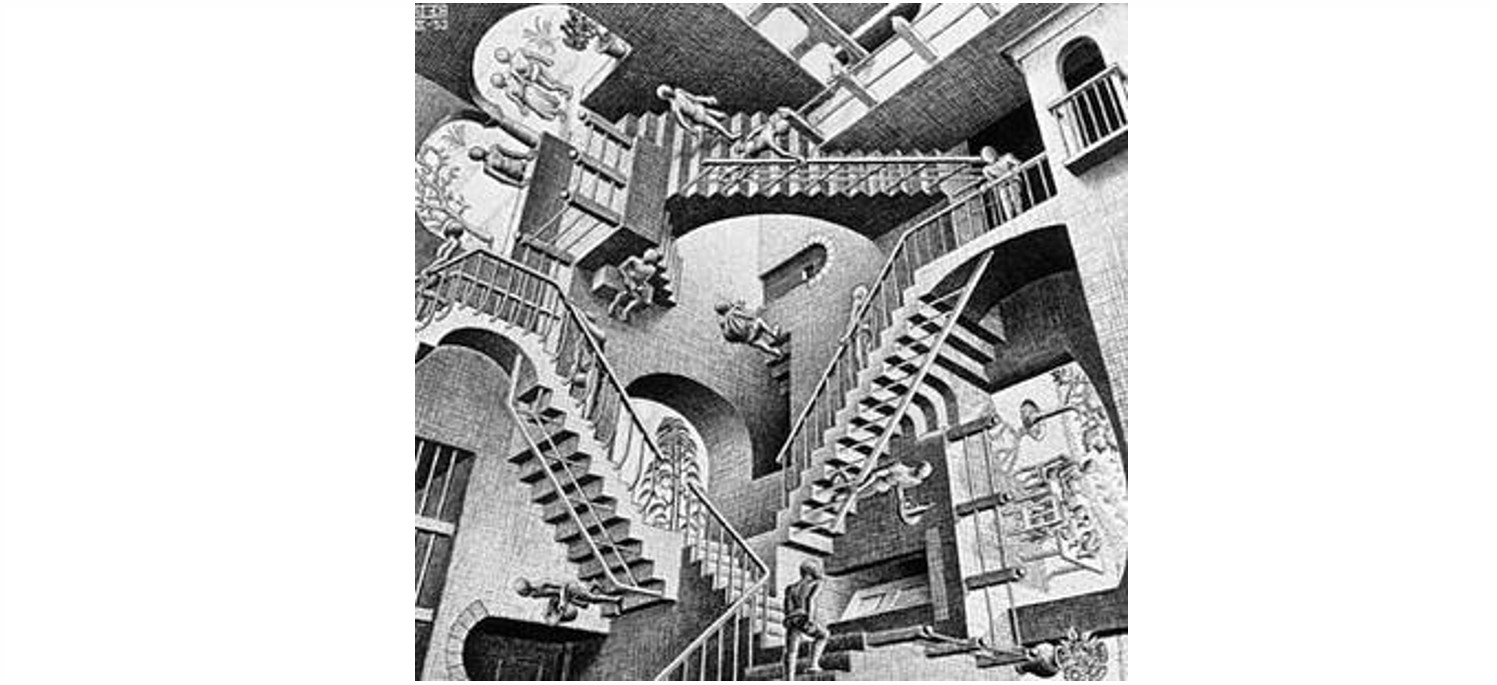
This is a poster of Relativity, a lithography printed in 1953 and also popularly known as "Crazy Stairs". It is one of the most iconic works of the famous dutch artist Maurits Cornelis Escher , who explored the fascinating boundary between art, mathematics, and visual perception.
In this lithography Escher creates an impossible architectural world where three different gravitational directions coexist. People walk up and down the same staircases, each obeying a different "down," yet all appear perfectly normal within their own local environment.
The image exploits the way our visual system interprets depth and perspective. Although every staircase, doorway, and figure is drawn according to the rules of linear perspective, the different viewpoints cannot be reconciled into a single three-dimensional structure. Our brain continuously attempts to build a coherent mental model of the scene, but no such model is physically possible. As our gaze moves across the image, perception shifts between different interpretations, creating a compelling visual paradox.
Escher had no formal mathematical training, yet his work has inspired mathematicians, physicists, psychologists, and vision scientists for decades. Relativity remains one of the best-known examples of how our perception of space is an active construction of the brain rather than a direct representation of reality.
Perception Insight
Your brain automatically assumes that gravity has a single direction. Relativity violates this fundamental expectation by presenting three incompatible "up" and "down" directions simultaneously. The resulting conflict reveals that what we see is not simply the image reaching our eyes, but the brain's interpretation of that image.
Ultimo aggiornamento
14.07.2026