
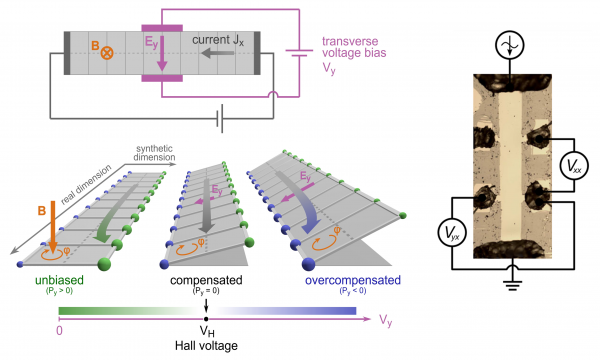
The Hall effect — based on the deflection of an electric current by a magnetic field — is a fundamental phenomenon in solid state physics. It is utilized in everyday devices for measuring magnetic fields and has played a pivotal role in the development of modern quantum physics. However, many "mysterious" aspects of the Hall effect observed in a wide range of materials still require further understanding.
In an article published in Nature Communications, researchers from our Department have discovered a new way to perform "electrical" measurements in a quantum simulator of the Hall effect. In this simulator, instead of electrons, a current of atoms controlled by laser light is used. The experimental group led by Leonardo Fallani, which includes researchers from LENS and CNR-INO alongside theoretical experts from the Universities of Grenoble and Geneva, has succeeded for the first time in measuring the Hall resistance in a system where atoms interact strongly with one another. This breakthrough paves the way for the study of previously unexplored regimes.
Full details: T.-W. Zhou et al., “Measuring Hall voltage and Hall resistance in an atom-based quantum simulator”, Nat. Comm. 16, 10247 (2025), https://doi.org/10.1038/s41467-025-65083-6